
What is the ideal size and shape of the palate?
I’ve brought this video as an illustration:
A holistic approach to palate expansion
In approaches that also consider airway health, the extent of palate expansion is determined not only by the space required for the teeth, but also by the anatomy needed for optimal breathing. A key principle is that proper breathing is essential for overall physical health.
The role of the palate
The palate also forms the base of the nasal cavity.
It determines the size of the dental arch.
If it is Gothic (high and narrow), it reduces space in the nose → affecting breathing → and overall health.
Surprisingly, it can even push the nasal septum, creating an anatomical obstacle to easy nasal breathing.
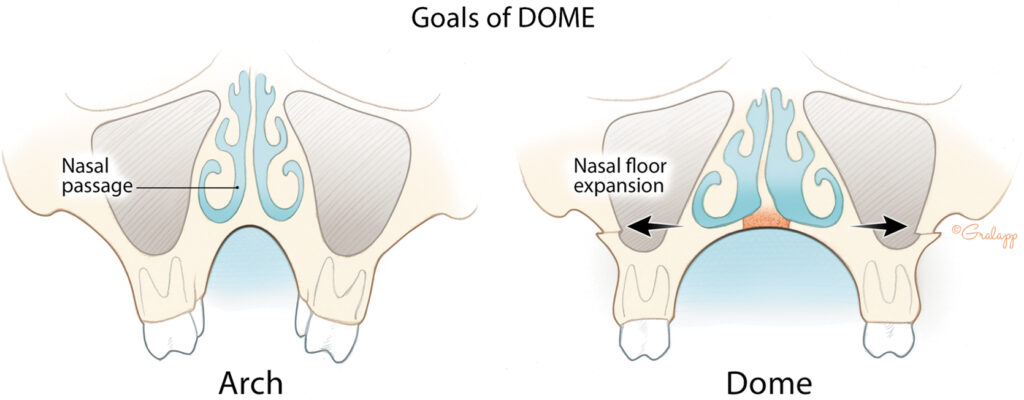
On the left image you can see a Gothic, narrow palate, while on the right an ideally shaped one.
Why does someone develop a narrow palate?
There can be many underlying causes, including:
- a short tongue-tie (which can be genetic!!)
- nasal congestion
- allergies
- mouth breathing
- enlarged adenoids
- hypotonia (low muscle tone)
- prolonged pacifier use or thumb sucking
- basically anything that forces the tongue away from the palate or prevents proper tongue posture
Why is expansion so important?
Optimizing anatomy for proper breathing is crucial. This is known internationally as an airway-focused approach in dentistry or ENT (ear, nose, and throat specialists).
Many dentists are satisfied if the teeth simply fit nicely (often without considering wisdom teeth), but this is largely an aesthetic goal.
😊 A beautiful smile truly shines when a person feels good in their body and is genuinely healthy.
👉The example of our ancestors
In the past, people had enough space even for their wisdom teeth → which shows that the natural, ideal palate and dental arch were wider and more airway-friendly.
If someone’s wisdom teeth do not have enough space, it indicates that the palate is not wide and flat enough—meaning it is not optimal for breathing. (This does not necessarily mean that the person already has breathing problems, but biologically everything has an optimal size.)
👩Personal experience
POV: My wisdom teeth didn’t have enough space—they grew in crooked, and several had to be surgically removed, even though…
👉My teeth may look straight, but in reality they are extremely crowded.
Key takeaway
Achieving an ideal dental arch and palate size for proper breathing is not just about aesthetics: restoring proper function and optimizing anatomy are equally important. In adults, unfortunately, there are only limited solutions available, and these tend to be more invasive.
However, in children, remarkable results can be achieved with gentle interventions! Supporting proper jaw development, identifying and addressing tongue function issues and structural differences can create significant improvements—not only for breathing, but also aesthetically.
International professionals increasingly use the phrase: “Airway first, teeth second.”
In other words, airway health comes first, and teeth come second.
Another common saying is: “Fix before 6.”
This means that jaw growth, tongue function, and facial muscle balance should ideally be guided before the age of six. The solution doesn’t happen overnight, but it’s worth assessing children even at preschool age, as clear signs can already be observed.
The importance of professional teamwork – together we are more!
An airway-focused, multidisciplinary approach is not yet widespread in our country, even though it offers huge benefits for both patients and professionals.
The Buteyko breathing method is brilliant, but anatomy sets a permanent limit on optimal breathing. That’s why I collaborate with dentists, speech therapists, and movement therapists—to address all contributing factors. The result is health optimized for breathing, both physically and mentally.
Dentists can assist with anatomical changes using various tools, depending on the individual and their starting point. Many breathing problems can be significantly improved with palate expansion and restoring proper function. For example, sleep apnea is one such condition. In our country, the standard “solution” is often a CPAP mask—but the issue is much more complex and requires a broader perspective, where more treatment options become available.
If you feel that this article resonates with you, consider joining one of my courses or booking a consultation.
You can also browse through many free videos and articles under the “Media appearances” section.