
Légzésszelidítő Children's Breathing Training
Help your child develop more functional breathing!
Just reminding them to close their mouth isn't enough 👄
If your child frequently breathes through their mouth during the day or while sleeping, you probably already sense that this isn’t simply a bad habit. Several different factors can play a role in why mouth breathing develops and persists, which is why constant reminders rarely bring lasting change on their own.
In the Légzésszelidítő children’s breathing training, I help you better understand which habits and functional factors may be keeping your child’s mouth breathing going. I teach you playful, personalized exercises so that, as a parent, you can consciously support your child at home on the way to more functional breathing.
✓ From 4–5 years of age, online
✓ A four-week program where parents take part in the sessions
✓ Personalized tasks based on a prior assessment
✓ A breathing-, tongue-, facial-muscle- and posture-focused approach
✓ If needed, a recommendation for further professional evaluation together with colleagues
Instead of bouncing between specialists, the picture of your child’s breathing and symptoms finally comes together. From there, you can consciously support them toward nasal breathing with playful methods that fit into everyday life.
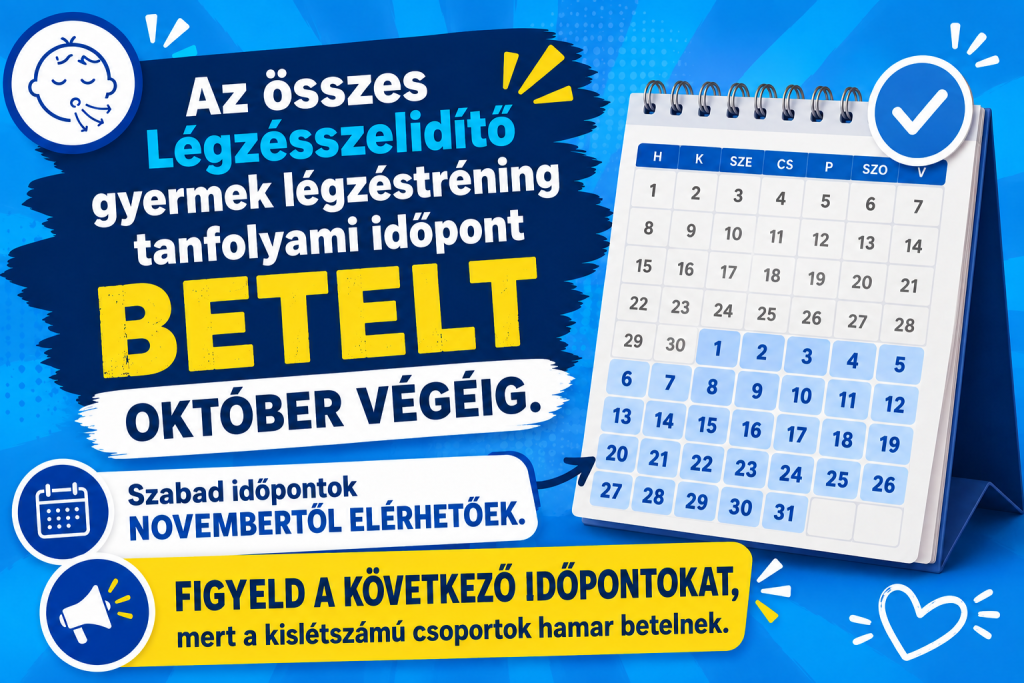
Not sure yet whether the training is right for your child? ⬇️
🤔 DOES ANY OF THIS SOUND FAMILIAR?
Do you recognize these signs too?
Sleep and nighttime
Snoring, sleeping with an open mouth, restless tossing and turning, waking up tired despite sleeping enough hours? Breathing pauses, teeth grinding, a drool-stained pillow? Or still wetting the bed at night?
Face, teeth, jaw
Crowded teeth, a long, narrow face, a high (gothic) palate, an open bite? Mouth breathing before or even after orthodontic treatment? No gaps between the baby teeth — or never were any?
Behavior and attention
Trouble concentrating, irritability, anxiety, learning difficulties — and nobody has ever brought up their breathing?
Breathing and health
Constant nasal congestion, recurring colds, allergies, asthma, tonsil problems?
Mouth and tongue
Mouth open even during the day, chapped lips, tongue hanging out, articulation issues, messy or noisy eating?
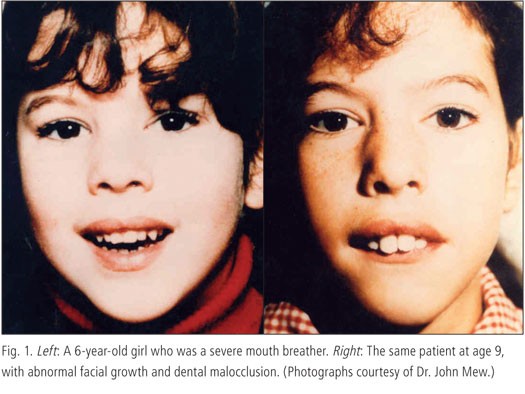
Mouth breathing is often driven by several interrelated factors at once: it could be a narrow nasal passage, incorrect tongue posture, weak facial muscle tone, a short tongue-tie, an “I can’t get enough air” feeling from overbreathing — or a combination of these.
If we only address one factor, the others keep the pattern going. That’s why a single exam, a single specialist, or a single set of exercises is often not enough.
If you’d like to better understand the complex background of breathing, listen to our conversation on Jazzy Radio, where we talked about this for about 12 minutes (in Hungarian).
How does Légzésszelidítés help? 🌬️
I don’t just hand out a few random breathing exercises. It’s a well-thought-out, personalized process built on three pillars.
🔍 Assessment Before we start anything, we work out what’s keeping your child’s mouth breathing going. A prior questionnaire, photos, a parental assessment — since you’ll be practicing at home too.
🎯 Personalized exercises Not every child gets the same set of tasks. The exercises are built around age, attention span, motor development and each child’s individual challenges — playfully, with stories, movement and humor. In a way the child actually enjoys — and will soon start asking for themselves.
🤝 Parent coaching and follow-up You learn both the theory and the practice of the method. I teach you how to pass it on to your child safely, effectively and enjoyably. Throughout the process, everyone moves forward individually on our private channels — so everything is genuinely tailored to you, day by day.
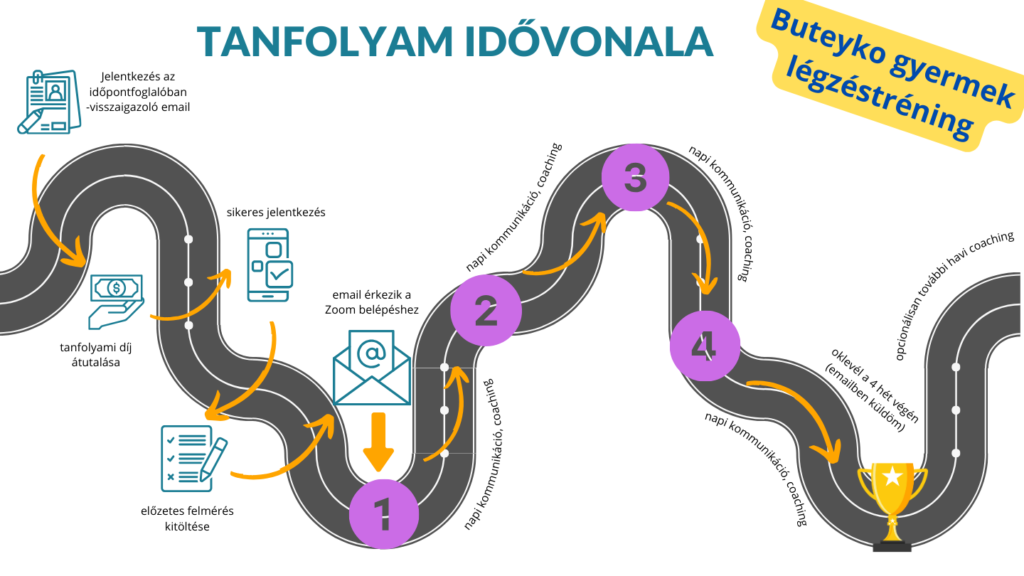
📚 The 4-week program, step by step
1
🔍 Initial assessment
An online questionnaire and photos — so even the starting point is already personalized.
2
💻 A weekly 2-hour online session
We meet over Zoom once a week for 4 weeks — you, the parent, learn the method.
3
🎈 Playful practice at home
Every exercise comes with a video made for children, which they can also do together with me.
4
💬 Daily coaching support
You’re never alone between sessions — daily contact through our private channel.
5
🏆 Wrap-up and follow-up
A certificate for the child, plus a 3rd/6th-month follow-up depending on the package.
✨ What can you realistically expect from the 4-week program?
Based on feedback and experiences from previous participants, the following changes may occur during the training:
Sleep
Sleep quality may improve, nights may become calmer, snoring may lessen or stop, and bedwetting may decrease or stop.
Allergies and breathing
Allergy symptoms may decrease, nasal congestion may clear up, and breathing may become quieter and more even.
Outward signs
Dark circles under the eyes may fade, and facial muscle tone may improve.
Mouth and tongue
A closed mouth may become more common, correct tongue posture may develop, and articulation and speech fluency may improve.
Attention and nervous system
Concentration may increase, attention may improve, and the child’s nervous system may become more balanced.
Eating
Food may be chewed more thoroughly, which can support digestion and dental development.
Health
Enlarged tonsils may start to shrink, and the body’s overall functioning may become more balanced.
Awareness
Children may become more aware of their own breathing and bodily functions, with a better understanding of why nasal breathing matters.
👉 Of course, these changes vary from child to child, but all of them are based on experiences that have already happened for previous participants.
What have previous participants experienced?
KIVÁLÓA Trustindex hitelesíti, hogy a vélemény eredeti forrása Google. A gyermek tanfolyamon való részvétel nekem egyszerre hozott megnyugvást, megértést és tudást. Viki kedves nyugalma, szakmai tudása, illetve a tapasztalata, minden kérdésünket megválaszolta és eloszlatta a kételyeinket, ami az évek során felmerült bennünk. A jutalomtábla nagyszerűen bevált a kislányomnál és a gyakorlatokat bemutató videók segítették a tanulás folyamatát. Egy hónap után már vannak mérhető eredményeink és a gyerekem tudatosabban lélegzik! Szívből ajánlom mindenkinek a tanfolyamot! ❤️ Kele KrisztaKözzétéve itt: GoogleA Trustindex hitelesíti, hogy a vélemény eredeti forrása Google. Gyermek légzés tanfolyamon vettem részt Vikinél. Nagyon hasznos volt, érthető! Mostmár átlátom kisfiam problémáját, így én is jobban tudom őt segíteni. A feladatok úgy vannak kitalálva, hogy a gyermek és szülő számára is élvezhető legyen. Még csak egy hónapja gyakorolunk, de már most látványos fejlődésen ment keresztül kisfiam. Bárki hezitál ne tegye, jelentkezzen Vikihez a tanfolyamra akár felnőtt, akár a gyermekéről van szó nem fogja megbánni :)Közzétéve itt: GoogleA Trustindex hitelesíti, hogy a vélemény eredeti forrása Google. Gyerek légzés tréningen nagyon sok hasznos információ birtokába jutottam. Külön segítséget jelentettek Viki jól felépített videós kiegészítő anyagai. Mindenkinek ajánlani tudom a tanfolyamot.Közzétéve itt: GoogleA Trustindex hitelesíti, hogy a vélemény eredeti forrása Google. Gyermek lègző tanfolyamon vettem rèszt mindkèt gyermekemmel. Nagyon sok hasznos dolgot tanultam, sok minden vilàgossà vàlt ès olyan eszközt adott a kezembe amivel segìthetem a gyermekeim egèszsègèt. Viki tudàsa, kedvessège, megnyugtatò az aggòdò szülők szàmàra. Mindenkinek ajànlom szìvből!Közzétéve itt: GoogleA Trustindex hitelesíti, hogy a vélemény eredeti forrása Google. Gyermek tanfolyamot végeztünk el Vikinél, ahol Viki nagyon jól elmagyarázta, hogy minden mindennel összefügg, és mennyire fontos szerepe van a nyelvnek és a légzésnek. Az 5 éves lányom a tanfolyam 3. hetén egyik nap úgy jött haza az oviból, hogy ,,Anya, az óvó néi nem jól tudja, mert azt mondta tornaórán, hogy az orron vegyük a levegőt, és a szánkon fújjuk ki, de az orrunkon kell kifújni is, nem? " Szóval valami elkezdődött, nagyon sok információt és tanácsot kaptunk, mire érdemes, és kell is odafigyelni, hogyan kell gyakorolni, így bízom benne, hogy sikerült megtalálni a helyes utat, és remélem rajta is tudunk maradni a gyerekekkel, hogy ne úgy járjanak, mint az anyukájuk, akinél 36 évesen derül ki, hogy kb 30 éve szájlégző, és erre vezethető vissza egy csomó tünete.Közzétéve itt: GoogleA Trustindex hitelesíti, hogy a vélemény eredeti forrása Google. Kisfiammal elvégeztük a tréninget, sokat segített az orrlégzésre való visszaszokásban. A kurzus átfogó ismereteket ad, a feladatok játékosak és változatosak, kisfiam szívesen csinálja őket. Fontosnak tartom, hogy van ilyen tanfolyam már gyerekeknek is, nem lehet elég korán a helyes légzés fontosságának tanítását elkezdeni. Ajánlom a tanfolyamot.Közzétéve itt: GoogleA Trustindex hitelesíti, hogy a vélemény eredeti forrása Google. Nagyon jó volt Vikivel tanulni! Maximális türelemmel és sok-sok példával magyaráz. Sok mindent tanultam ilyen rövid idő alatt is, amit a mindennapokban is tudok használni.Közzétéve itt: GoogleA Trustindex hitelesíti, hogy a vélemény eredeti forrása Google. Hasznos információkat kaptam, a gyakorlatok, amiket javasolt Viki, tetszenek a gyerekeknek. Személy szerint elmondta mi a probléma, hogyan lehet javítani a helyzeten.Közzétéve itt: GoogleA Trustindex hitelesíti, hogy a vélemény eredeti forrása Google. Számomra hatékony és hasznos volt a tanfolyam. Viki empatikus és rendkívül jól képzett szakember. Utána olvastam a helyes légzésnek, de Viki gyakorlatai és tanfolyama rendszert hoztak és sok újdonságot. Köszönettel, Fábián AnnamáriaIgazolta: TrustindexA Trustindex hitelesített jelvénye az Egyetemes Bizalom Szimbóluma. Csak a legjobb vállalatok kaphatják meg a hitelesített jelvényt, akiknek az értékelése meghaladja a 4.5 értéket, az elmúlt 12 hónap vásárlói véleményei alapján. További információ
What is the program not about?
❌ it is not tongue-thrust swallowing therapy, though it prepares well for it and we do learn about it
❌ it is not articulation therapy, though there are specific exercises that support it
❌ it is not personalized motor development, since no dedicated motor assessment is carried out (although we do assess motor development progress)
❌ it is not medical care, and no diagnosis is made
❌ it is not special-needs education, though I support every child according to their own individual needs 🩷
🌟 Why Légzésszelidítés?
Légzésszelidítés is far more than a general Buteyko training. I’ve complemented my own, self-developed breathing exercises with knowledge about children’s development, tongue and facial-muscle function, posture, movement, and dental correlations.
👧 Designed for today's children
As a movement-development children’s yoga instructor, I take into account the child’s age, nervous-system maturity, attention and sensory characteristics, any signs pointing to lingering infant reflexes, as well as their motor development.
That’s why children don’t simply get scaled-down adult exercises, but playful tasks that make sense to them and keep them motivated. 🎈
Just because a child is physically capable of doing a breathing exercise doesn’t automatically make it a child-friendly exercise.
🧩 Not just breathing exercises, but interconnected systems
My own, self-developed exercises support more than just nasal-breathing awareness. In the training we also work on tongue position 👅, lip and facial muscle function, posture and movement fundamentals — always adapted to the child’s individual situation and age.
🌍 Continuously growing international knowledge
As the only Hungarian member of Airway Circle, week after week I learn from international experts on breathing, sleep, orofacial function and jaw development.
I incorporate the relevant, up-to-date professional knowledge I gain there into the approach and educational materials of the training. 📚
🤝 Professional collaboration
I work as part of a professional team together with a pediatric dentist 🦷, an orthodontist, a speech-language pathologist / myofunctional swallowing therapist, and movement-development specialists.
If a sign comes up that may need further evaluation, I help you find the right professional direction.
🌊 A wave of support for real effectiveness
Parents take part in the online sessions, but through the breathing-exercise videos I’m also “there” during practice at home. 🎥
A scratch-off reward chart motivates children to keep up with regular practice. 🎁
👩👦 I'm in it too: I live it, I feel it, I understand it!
As a mother myself, I’ve walked — and am still walking — my own son’s often bumpy path with breathing, tongue function, motor development and dental development.
That’s why with Légzésszelidítés you get more than just well-built exercises: you get clear explanations, personalized guidance and ongoing support. 🌱
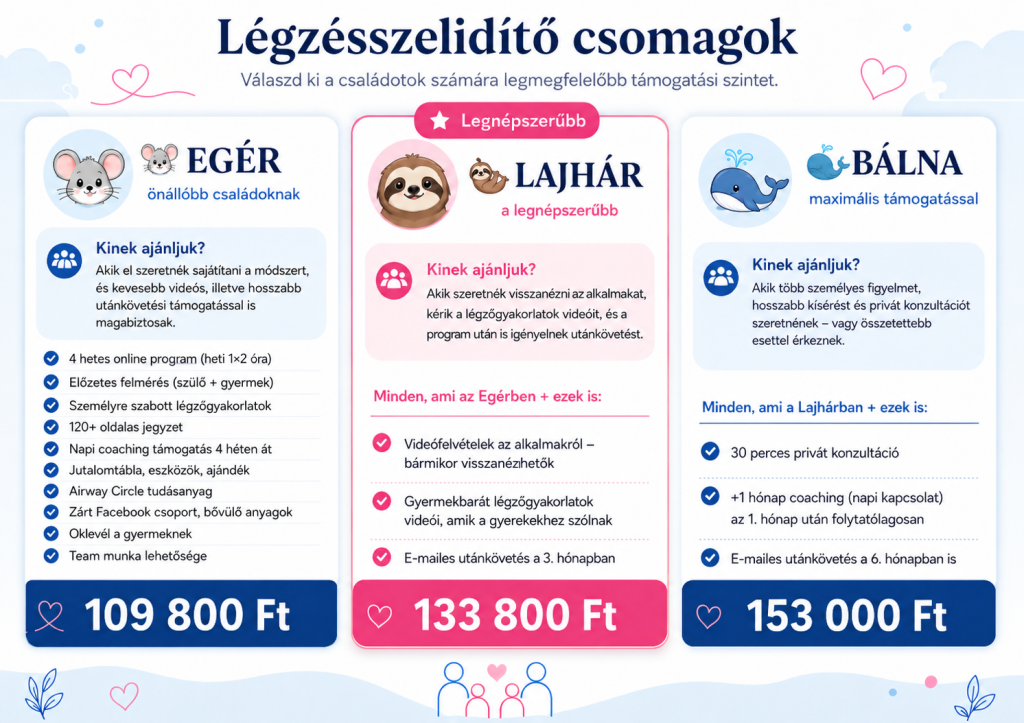
The training fee can be paid directly after booking, by bank transfer. You’ll receive the transfer details by email once you’ve booked.
Other add-on options:
- including siblings in the program: with 2 or more children, you don’t need to pay for 2 full packages — there’s just a very favorable sibling surcharge. In that case, please get in touch by message or phone.
- an ongoing monthly coaching arrangement is also available if you’d like longer-term support
How to sign up
You can see the available time slots and book your spot on our own booking page.
GET A SNEAK PEEK at the 1st session's topics!
🌀 Session 1 -- Foundations and getting started
Assessment and tests
- Observing current breathing patterns, building body awareness
- Simple, interactive tests to try at home
- A short interpretation of the results, setting goals
Understanding correct breathing
- Introducing diaphragmatic breathing and correct biomechanics
- What counts as non-optimal?
- Pitfalls, tips and tricks
- The benefits of nasal breathing
Introducing the exercises
- Lead-in exercises you can try right away
- Types and categories of breathing exercises
- Examples that fit into a daily routine
- Self-developed exercises — you won’t find these anywhere else!
Parental support
- How to introduce it playfully?
- Giving feedback to your child
- Tips for cooperation
Tongue position
- The importance of correct resting tongue posture
- First simple lead-in exercises
- Why the tongue’s functionality matters
Practicing at home
- Using the Facebook support group
- A practice framework and motivation
- The role and use of the reward chart